Hello everyone! Today I want to talk about a shocking revelation from a recent parliamentary audit regarding the Korea National Oil Corporation (KNOC). Despite losing 130 billion won (approximately $97 million) on a project, top executives continued to receive their hefty salaries without any reduction. What exactly happened here?
📰 What Happened
The Korea National Oil Corporation pursued the 'Blue Whale Project' (Daewanggorae Project) - a national resource strategy initiative aimed at developing deep-sea oil fields in the East Sea. However, after 47 days of drilling, they failed to discover economically viable gas, resulting in approximately 130 billion won in losses.
The problem is that despite these massive losses, executive compensation remained completely unchanged.
💰 Executive Compensation Breakdown
Let's look at President Kim Dong-seop's case:
2024
- Annual salary: 137.87 million won
- Performance bonus: 48.16 million won
2025 (through August)
- Annual salary: 94.4 million won
- Performance bonus: 53.98 million won
Other executives also received multi-million won performance bonuses and substantial annual salaries. On top of this, the president received 1.4 million won monthly in business promotion expenses.
😤 The Bigger Problem: Wage Gap by Grade
What's even more infuriating is the wage disparity by rank:
- Grade 1 Executives: Average annual salary of 123.61 million won + performance bonus of 35.01 million won
- Grade 5 and Below Employees: Average annual salary of 53.63 million won (actually reduced)
The responsibility for losing billions of won should lie with top management, yet it's the lower-level employees who are tightening their belts.
🔍 Why Was the Blue Whale Project Pursued?
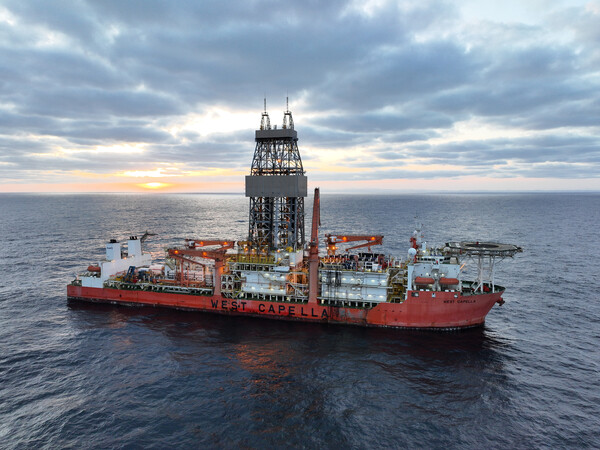
This project wasn't just about resource development. It had strong political symbolism.
Background
South Korea has an energy resource dependency rate exceeding 90%. When the possibility of up to 14 billion barrels of oil and gas being deposited in the East Sea's Block 8 was raised, the Yoon Suk-yeol administration actively pursued this as "the greatest resource development opportunity of the 21st century."
In June 2024, then-President Yoon made this project the subject of his first national policy briefing. It was unusual for a president to personally announce something typically handled by the Minister of Industry. At the time, he claimed "massive resources are buried in Yeongil Bay" and used grand descriptors like "five times Samsung Electronics' market cap."
Credibility Issues
However, the company that analyzed the 14 billion barrel potential was problematic. The American firm ACT-GEO turned out to be essentially a one-person operation with a history of corporate tax delinquency. Billions of won in taxpayer money were invested based on this company's analysis.
Ultimately, the drilling results showed only 6.3% gas saturation, deemed economically unviable.
⚖️ Political Controversies
This project became embroiled in several political controversies:
- Approval Rating Boost Suspicion: Some suggested it was a strategic announcement to boost declining approval ratings.
- Insider Trading Suspicions: Resource-related stocks surged after the announcement, raising questions about possible insider trading.
- Conflict with Parliament: The National Assembly completely cut the 49.7 billion won budget for the Blue Whale project in the 2025 budget, and former President Yoon cited parliamentary obstruction as one reason for declaring martial law, intensifying the conflict.
- Local Community Damage: Pohang fishermen claim they suffered billions of won in losses to snow crab fishing due to drilling operations and are demanding compensation, but negotiations remain stalled.
- Bizarre Performance Evaluation: Despite the exploration failure, KNOC's internal 'Blue Whale Team' received the highest grade (S-grade) in performance evaluations. The justification was "contributing to resolving public doubts," which is difficult to understand for a failed project.
🛠️ How Should Public Institution Wage Systems Change?
This incident exposed fundamental problems in public institutions' wage systems and performance bonus structures. Government and policy research organizations are proposing the following improvements:
Expanding Performance-Based Pay and Job-Based Pay Systems
There needs to be a shift from the traditional seniority-based system to one where compensation is differentiated based on job difficulty and actual performance. Particularly for senior positions, the system should be designed to allow performance bonus reductions or non-payment when performance targets are missed.
Reforming the Management Evaluation System
Moving from relative evaluation to absolute evaluation to reduce excessive competition between institutions, with separate management contract evaluations for agency heads also under consideration.
Expanding Autonomy in Total Personnel Cost Management
While loosening personnel and wage controls for market-type and listed public corporations to increase autonomy, self-funded institutions need a personnel cost determination structure distinct from budget-dependent institutions.
Improving the Wage Peak System
The wage peak system, which reduces wages before retirement, is criticized for lack of effectiveness and needs improvement through linkage with retirement age extension or gradual reduction.
🗣️ Lawmaker Kim Dong-ah's Criticism
Lawmaker Kim Dong-ah criticized the situation in the parliamentary audit:
"It's a betrayal of the public for a public corporation operating on taxpayer money to enrich only top management despite billions in losses. Urgent reform of the wage system aligned with performance and responsibility is needed."
This is absolutely right. Public institutions operate on taxpayer money, so performance and responsibility must be clearly linked.
💭 In Conclusion
The Blue Whale Project raises complex issues surrounding policy decision transparency, resource development effectiveness, and political accountability.
Above all, this incident poses a clear question:
"Who do public institutions exist for?"
If public institutions exist for the people, taking responsibility for failures should be natural. If performance bonuses are paid despite no results, and executive salaries remain unchanged despite losses, then these aren't public institutions but privileged groups.
I hope that public institution wage systems and performance evaluation structures will be fundamentally reformed to truly serve the people.
What do you think about this issue? Please share your thoughts in the comments! 👇
This article was written as of October 7, 2025.
'건강 오늘은' 카테고리의 다른 글
| How to Lower Blood Pressure - Complete Guide from Symptoms to Diet and Medications (1) | 2025.10.17 |
|---|---|
| Belly Fat Can Raise Endometrial Cancer Risk Up to 6 Times — Here’s How to Prevent It (0) | 2025.10.08 |
| 제로슈가 안전성 대체 감미료는? (1) | 2025.04.21 |
| 와사비잎 추출물의 효능은? (0) | 2025.04.20 |


